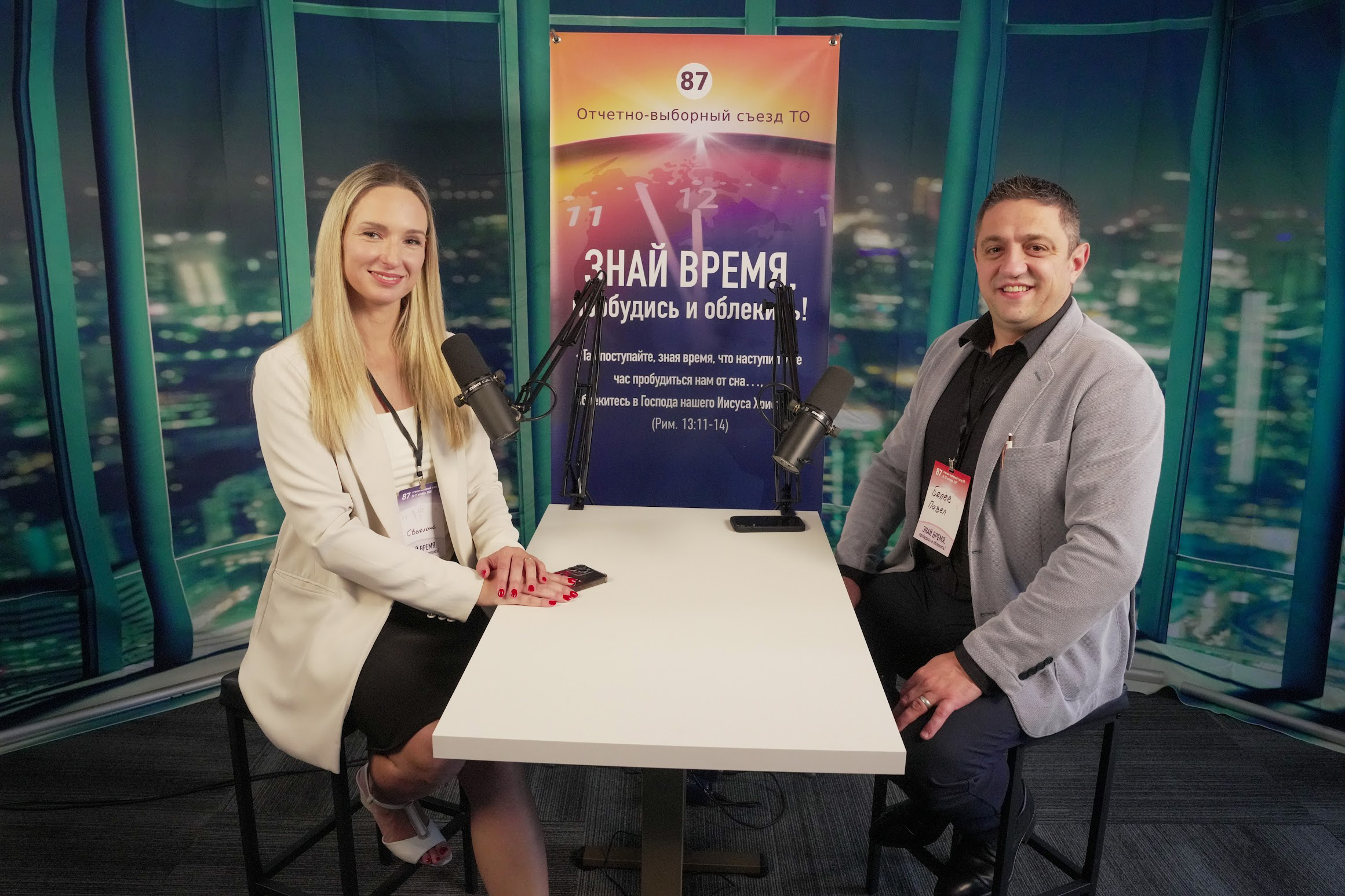
At the 87th Convention of the Pacific Coast Slavic Baptist Association, an interview was held with Pavel Belev, pastor of the Spring of Life Church (Mukilteo, Washington) and the newly elected Vice President of the PCSBA. We spoke about his new role, the place of the church in today’s world, technology, pastoral responsibility, and the importance of churches unity. Below is the interview conducted by Svetlana Iotko, correspondent for the Information Department.
S.I.: Pastor Pavel, please tell us a little about yourself and the ministry to which you were elected.
P.B.: My name is Pavel Belev, and I am the pastor of the Spring of Life Church in Mukiltey, Washington. At this convention, I was elected to serve as Vice President of the PCSBA. Simply put, my role is to support the President of the Association, Alexander Borisovich Pronin through joint discussions, developing strategic vision, and working with various departments. First and foremost, it is a ministry of assistance and support.
S.I.: Your church is known for being very active. Would you say you are ready for such a ministry?
P.B.: Yes, and that is precisely why we joined the Association some time ago. We believe in the principle of synergy: when efforts are united, the result is greater than the sum of individual actions. We were looking for churches that are as active as we are, so that together we could serve the Lord more effectively.
S.I.: The theme of the convention is “Know the Time—Awake and Be Equipped.” What does this mean personally to you?
P.B.: I would put it in coastal terms: catch the wave. It’s not enough just to see the wave—you have to jump on it at the right moment and know how to ride it. “Knowing the time” means understanding the era we live in, the culture, and the needs and concerns of people. The church is called to be on the crest of that wave, responding in a timely way to the challenges of the day.
“To awaken” means to rise at the right time and begin to act. And to be “equipped” means to be spiritually prepared, armed with the truth of God’s Word, in order to truly respond to the real needs of the world around us.
S.I.: We live in an age of technology. How do you view modern trends and their influence on the church?
P.B.: These trends need to be understood. Technology is a tool. Some things can and should be used—but not everything, and not thoughtlessly. When electronic Bibles first appeared, they sparked a lot of debate, but today we understand that they are simply a convenient tool. They do not replace spiritual life; they can only enrich it.
S.I.: Do you use technology in preparing your sermons?
P.B.: Yes, I do. For example, to search for Bible verses or historical illustrations that help explain a topic more clearly. Sometimes you remember the idea but not the exact quotation—search tools help with that. But it’s important to understand that no technology can replace revelation from God or living spiritual fellowship with the church.
S.I.: How do you feel about pastors and ministers being present on social media?
P.B.: I believe that a pastor is first and foremost a local servant, appointed by God to care for specific people in a specific church. Without personal contact, true pastoral care is impossible. Online presence can be a helpful addition, but if it begins to replace ministry in the local church, that becomes a problem.
At the same time, media ministry is an important tool for people outside the church—for those who live in isolation or in countries where Christianity is restricted. This should not be neglected. Still, a pastor’s priority must remain his living, local congregation.
S.I.: How painful is it for you when people leave the church?
P.B.: When people leave for the world, it is very painful. When they move to another church, the reasons vary. But when people repent and come to the Lord—that is great joy. I believe that God does not give a pastor more people than he is able to care for. This is God’s church, and He cares for it more than we do.
Over time, trust in God grows: if He has entrusted these people to me, then He believes I am able to care for them. If there are no more people, then it means we must faithfully serve those we already have.
S.I.: Your church is one of the youngest in the Association. How would you motivate other churches to join?
P.B.: I believe in the power of working together. When several churches unite, they can do more and do it better—whether in missions, youth ministry, or large events. My argument is simple: let’s do more together, and do it with greater quality.
S.I.: What would you like to wish to ministers and churches?
P.B.: That this motto would truly come to life. We need to make an effort, be active, and pay close attention to ourselves and to our teaching, as the Apostle Paul wrote. To awaken, to act, to support and encourage one another, stirring one another up to love and good works. Blessings to everyone!
Svetlana Iotko